Inside the Pentagon’s Crackdown: The True Impact of Pete Hegseth’s Military Beard Policy
In June 2026, Defense Secretary Pete Hegseth boarded a U.S. Navy ship for a routine visit amidst simmering tensions with Iran. What was supposed to be a standard operational engagement quickly turned into an internal Pentagon firestorm. The reason? Facial hair. Hegseth observed several sailors sporting beards, seemingly in direct defiance of the stringent military grooming policy he spearheaded last year.
According to internal Pentagon emails referenced by CNN, this single visit triggered a massive administrative push. Officials informed subordinates that Hegseth is closely monitoring compliance, writing, “The push is to move faster … there is a need to revamp some of our timelines.”
This accelerated enforcement highlights a severe cultural and operational shift within the armed forces. For well over a decade, the U.S. military had increasingly granted accommodations for facial hair. Now, the era of the military beard is facing a swift, heavily scrutinized execution.
The “No More Beardos” Directive
The roots of the current crackdown trace back to September 2025. Addressing hundreds of generals and senior non-commissioned officers at Quantico, Hegseth delivered a blunt mandate.
“No more beardos,” the Defense Secretary declared. “The era of rampant and ridiculous shaving profiles is done.”
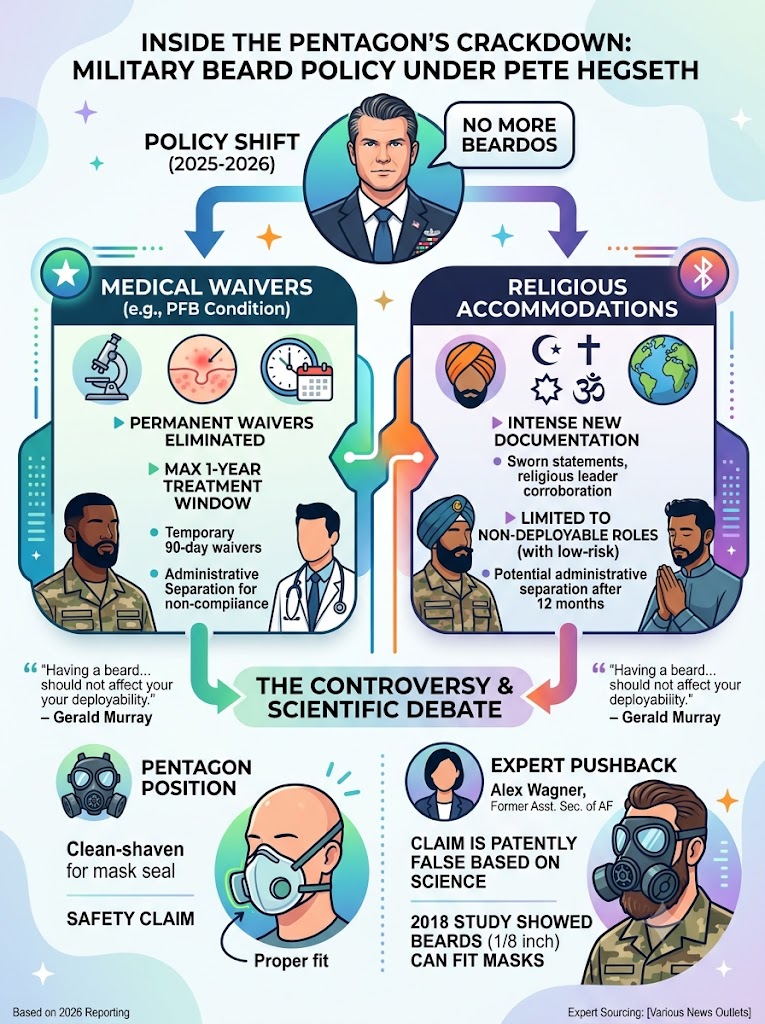
Shortly after, the Pentagon released a September 30 memo on “Grooming Standards for Facial Hair Implementation.” The directive effectively rolls back the military’s approach to facial hair to pre-2010 standards. Under the new framework, the Pentagon is moving aggressively to close the two primary avenues service members use to grow beards: medical waivers and religious accommodations.
Key Policy Takeaways:
- Medical Limit: Sailors with shaving-related skin conditions face a strict one-year treatment window to meet the clean-shaven standard.
- Deployability Clause: Service members with religious beard accommodations are restricted to non-deployable roles.
- Administrative Separation: Failure to deploy for 12 consecutive months leaves personnel vulnerable to administrative discharge.
- Waiver Scrutiny: Approvals now require immense documentation, including sworn statements of faith and religious leader corroboration.
Medical Waivers and the 365-Day Clock
Historically, service members suffering from severe skin conditions caused by shaving—most notably pseudofolliculitis barbae (PFB)—could receive permanent shaving waivers. PFB causes painful inflammation and disproportionately affects Black men; data from the American Osteopathic College of Dermatology indicates that up to 60% of Black men may experience the condition.
Under Hegseth’s updated grooming policy, permanent medical waivers are extinct.
The Navy’s subsequent July directive lays out the new timeline. Sailors with skin irritation are allowed a maximum of four temporary 90-day waivers, which must align with prescribed medical treatments. If a sailor cannot comfortably shave after one year of treatment, they are deemed to have “an unmanageable permanent condition.”
The resulting action is severe: recommendation for administrative separation due to failure to comply with grooming standards. Critics argue this effectively forces highly trained, capable service members out of the military over a dermatological condition.
The Rollback of Religious Accommodations
Since 2010, Sikhs, Muslims, Norse Pagans, and other faith groups have been permitted to wear beards in uniform under religious accommodations. Hegseth’s policy places an enormous procedural burden on these troops.
A follow-up memo issued on March 11, 2026, required service members currently holding religious accommodations to submit extensive new documentation by June 11. This included a sworn written statement affirming the sincerity of their belief, an explanation of how the clean-shaven requirement burdens their faith, and corroborating statements from community religious leaders.
Furthermore, the policy targets the core of a service member’s career: deployability. The September 2025 memo states that religious beard waivers “will be limited to non-deployable roles with low risk of chemical attack or firefighting requirements.” Because going 12 consecutive months without deploying leaves personnel vulnerable to administrative separation, the policy quietly functions as a career ender.
The Sikh Coalition publicly stated it is “angered and deeply concerned” by the directives. Hegseth, however, has dismissed concerns about limiting faith-based waivers, stating bluntly, “We don’t have a military full of Nordic Pagans.”
Scientific Pushback: Do Beards Actually Break Mask Seals?
The official justification for the military grooming policy centers on safety. The military has long maintained that troops must be clean-shaven so that gas masks and chemical respirators seal tightly against the face.
However, experts are publicly challenging the scientific basis of this claim.
Former Assistant Secretary of the Air Force for Manpower and Reserve Affairs Alex Wagner called the chemical seal argument “patently false based on the science.” Wagner points to a 2018 study demonstrating that 98 percent of participants with an eighth-inch beard achieved acceptable fits on civilian negative-pressure respirators—equipment highly comparable to the military’s current M-50 gas masks.
Veterans are also speaking out against tying religious accommodations to deployability. Gerald Murray, the former Chief Master Sergeant of the Air Force who served 29 years, was blunt in his assessment: “Having a beard for religious accommodations should not affect your deployability. That is not fair, and that is not the way to do it.”
Why did the military ban beards in the first place?
The military’s strict clean-shaven rule originated during World War I in response to the introduction of poison gas on the battlefield. Troops were required to shave to ensure that rudimentary gas masks could seal tightly against their skin to prevent deadly leaks. Over a century later, this rationale remains the primary institutional defense for the grooming standard.
Can you still get a religious waiver for a beard in the military under Pete Hegseth?
Yes, but the process is significantly more restrictive. Service members must provide sworn written statements and corroborating evidence from religious leaders. Furthermore, if approved, the service member is placed in a non-deployable role—a status that can trigger administrative separation if maintained for 12 consecutive months.
Sources Quoted:
Data, historical context, and direct quotes were sourced from current reporting by CNN, Air & Space Forces Magazine, Task & Purpose, Hindustan Times, and Military.com, referencing public memos, the American Osteopathic College of Dermatology, and statements by Pete Hegseth, Alex Wagner, Gerald Murray, and the Sikh Coalition.

Leo Falsafi is a digital marketing veteran and senior journalist at Virlan.co, where he covers the intersection of digital marketing, gaming, and breaking US trending news. With nearly two decades of hands-on experience in SEO and digital strategy, Leo has consulted for and scaled hundreds of companies. His deep industry roots allow him to deliver sharp, fact-checked insights and analysis on the trends shaping today’s digital landscape.