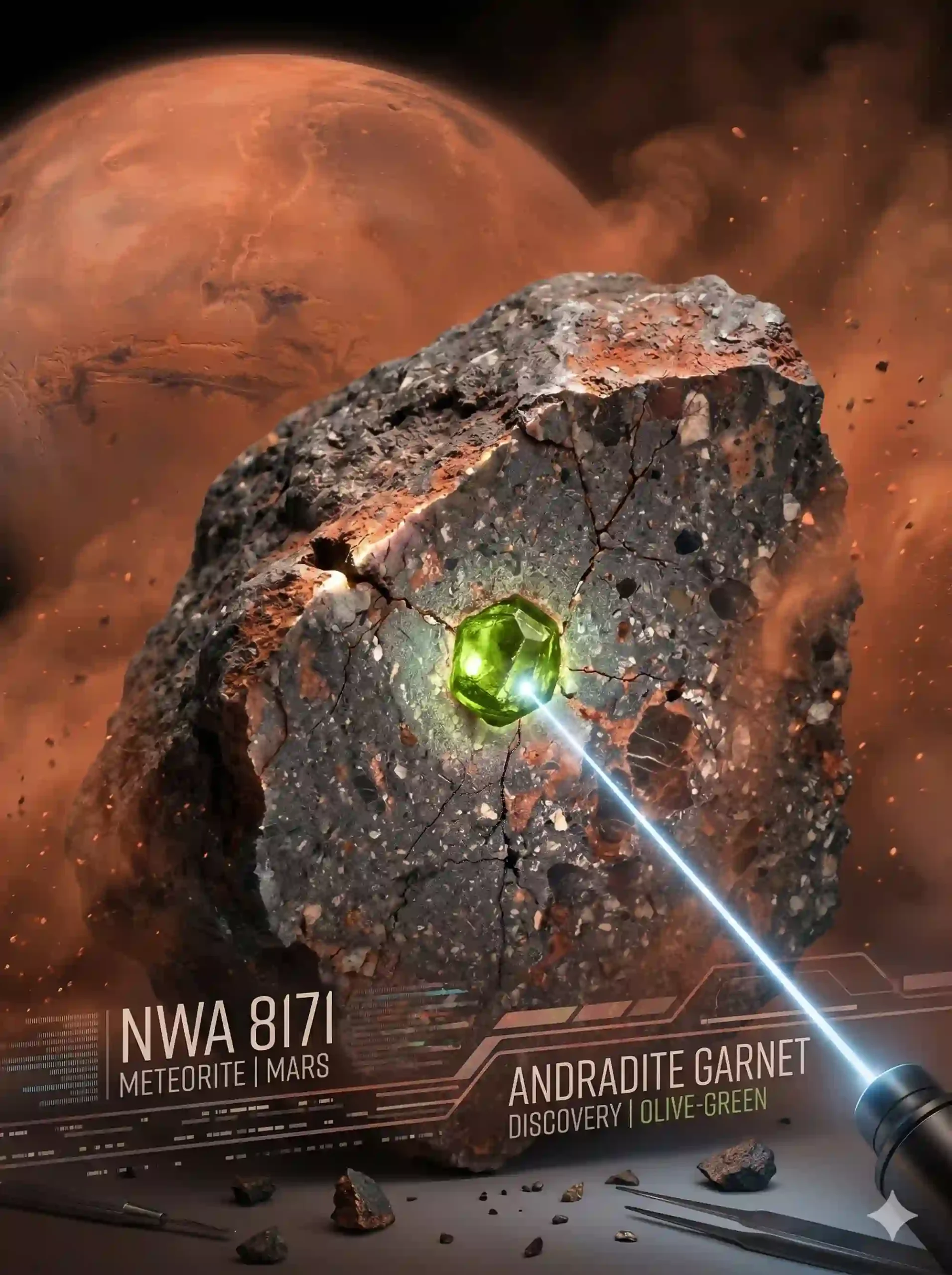
For decades, scientists have peered at the Red Planet, mapped its barren surface, and analyzed the rare meteorites that have crash-landed on Earth. We thought we had a decent grasp on the mineral makeup of our celestial neighbor. But sometimes, the universe hides its biggest secrets in the smallest packages.
In an unprecedented geological twist, an international team of researchers has just discovered garnet in a Martian meteorite—a first in planetary science that threatens to rewrite what we know about the 4.5-billion-year history of Mars.
Here is a deep dive into the discovery, the tiny rock that changed the game, and what it means for the future of Martian exploration.
The Seed-Sized Time Capsule: Meteorite NWA 8171
The hero of this story is a Martian meteorite known as NWA 8171, a rare piece of basaltic breccia currently housed in the collections of the Royal Ontario Museum (ROM). Martian meteorites are basically cosmic shrapnel; they break away from Mars during massive impacts and travel through the void of space before eventually falling to Earth.
While analyzing a fragment of NWA 8171 measuring roughly 0.8 by 0.5 millimeters (smaller than a poppy seed), a research team led by Earth Sciences Assistant Professor Tanya Kizovski of Brock University noticed something chemically odd. Initially, the team assumed the grain was pyroxene, a highly common mineral found in Martian rocks. However, after taking a second look using the ROM’s specialized laser equipment, they realized they were staring at something entirely different: andradite.
Andradite is an iron-rich form of garnet. Unlike the deep, blood-red gemstone prized by Victorian elites and ancient Egyptians, this Martian andradite sports an olive or yellowy-green hue, allowing it to camouflage perfectly among other meteorite minerals.
Why is Garnet on Mars Such a Big Deal?
On Earth, garnet is a classic metamorphic mineral. It doesn’t just pop into existence; it is forged under intense, specific conditions involving extreme heat, crushing high pressure, or complex chemical alterations involving hot fluids deep within the crust.
Until this discovery, these precise, intense geological conditions had never been definitively proven to exist on Mars to the extent of forming garnet. Finding andradite in a Martian rock implies that the Red Planet may have experienced far more complex and violent geological processes than current models suggest.
So, how did it form? Researchers propose a few tantalizing theories:
- Cataclysmic Impacts: The extreme heat and pressure required to forge the garnet could have been generated by a massive asteroid slamming into the Martian surface.
- Magmatic Intrusions: Magma rising violently into the Martian crust could have provided the necessary thermal pressure.
- A New Martian Rock Type: The discovery might indicate an entirely new, previously unrecognized category of Martian rock formed through unknown metamorphic or metasomatic processes.
The “Extra-Martian” Caveat and What Comes Next
While the scientific community is buzzing, the researchers—including experts from the University of Toronto, University of Portsmouth, and Universita di Trieste—are maintaining rigorous scientific caution.
There remains a possibility of an “extra-Martian” origin. It is possible that the garnet didn’t form on Mars itself, but was instead delivered to the Red Planet via a different meteorite impactor before eventually being blasted off to Earth.
To solve this, scientists need to examine the rock’s oxygen isotopes. Isotopic signatures act like a planetary fingerprint, which would definitively confirm if the garnet was born on Mars or somewhere else in the solar system. The catch? Analyzing isotopes often requires destroying the sample. Because this microscopic grain is currently the only known garnet-bearing Martian rock in our possession, researchers are hesitant to obliterate it just yet.
For now, this poppy-seed-sized grain of olive-green garnet stands as a monumental reminder: Mars is not just a dead, static rock. It is a dynamic world with a deep, violent, and complex history that we are only just beginning to uncover.
Source Report: This article synthesizes findings from researchers including Tanya Kizovski (Brock University), James Darling (University of Portsmouth), and Ana Černok (University of Trieste), based on their study published in the journal Geochemical Perspectives Letters, and quoted by news outlets such as ScienceAlert, Click Petróleo e Gás, Agenzia Nova, and NOTL Local.

Leo Falsafi is a digital marketing veteran and senior journalist at Virlan.co, where he covers the intersection of digital marketing, gaming, and breaking US trending news. With nearly two decades of hands-on experience in SEO and digital strategy, Leo has consulted for and scaled hundreds of companies. His deep industry roots allow him to deliver sharp, fact-checked insights and analysis on the trends shaping today’s digital landscape.