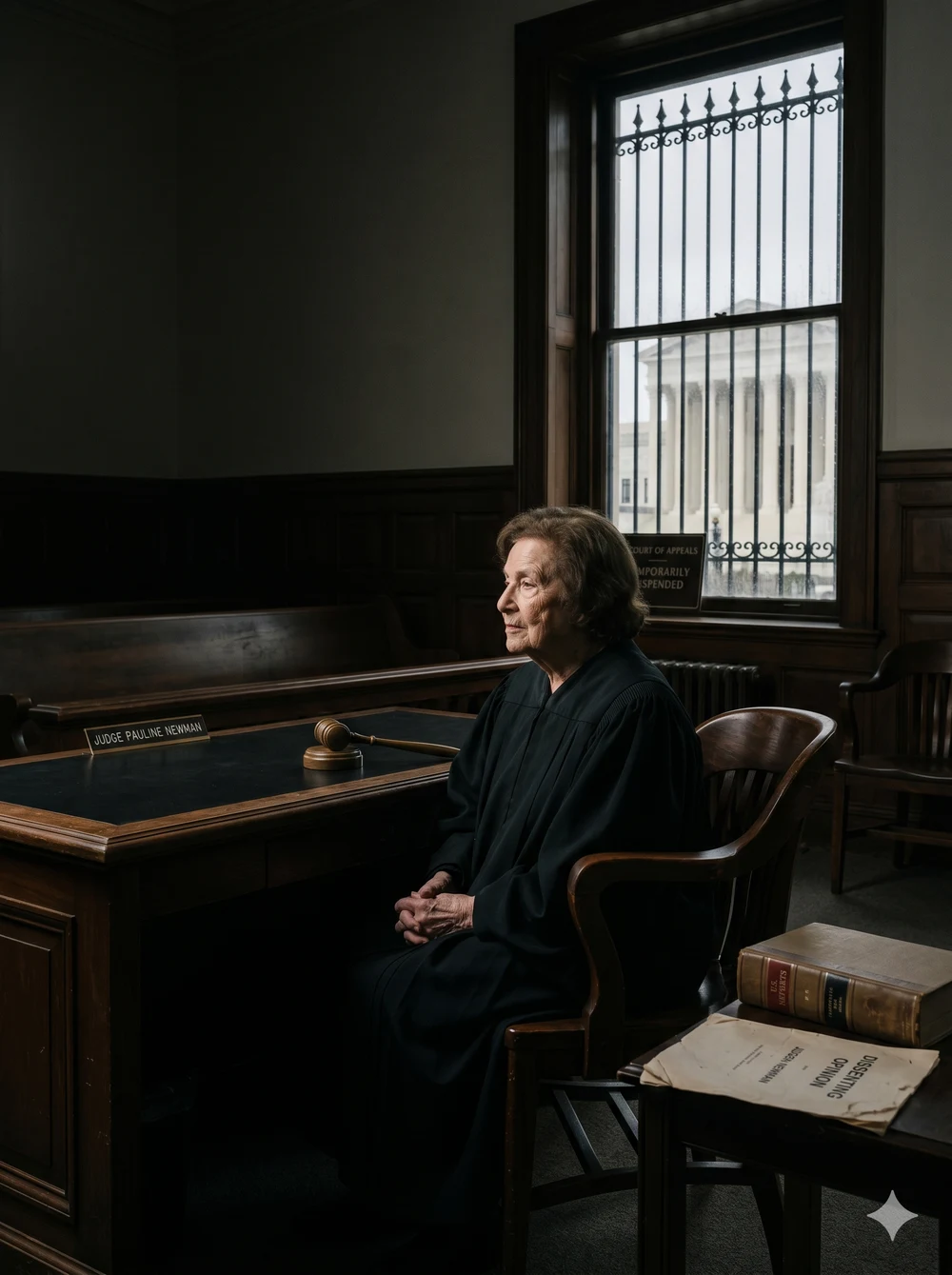
If you want to understand the fragile nature of judicial independence in America today, you don’t need to look at the Supreme Court. You need to look at the U.S. Court of Appeals for the Federal Circuit, where a 98-year-old judge has been barred from the bench for nearly three years in a move her advocates call an administrative coup.
Judge Pauline Newman, appointed by Ronald Reagan in 1984, is a towering figure in patent law. Across her four decades on the bench, she earned the moniker the “Great Dissenter” for authoring over 300 dissenting opinions. But today, the only thing she is dissenting against is her own suspension—a legal battle that recently reached the doors of the Supreme Court and was quietly turned away.
The Anatomy of a Suspension
The conflict began three years ago when Chief Judge Kimberly Moore identified a judicial complaint against Newman, then 96. Citing a fainting episode in 2022, health issues in the summer of 2021, and concerns from court staff regarding Newman’s ability to keep pace with her workload, Moore offered Newman a choice: retire, or take “senior status” (a semi-retired role with a lighter docket).
Newman refused both.
In response, Moore and a special committee of two Federal Circuit judges ordered Newman to submit to neurological and neuropsychological testing, turn over her medical records, and sit for an interview. Newman countered by providing expert reports from two doctors of her own choosing, asserting her continued fitness.
Unmoved by Newman’s independent medical clearances, the committee recommended Newman be barred from hearing any cases for a year. The Judicial Council approved this suspension in September 2023, renewed it in September 2024, and renewed it yet again in August 2025.
An End-Run Around Impeachment?
Newman’s legal team, led by the New Civil Liberties Alliance (NCLA), argues that the Judicial Council’s actions amount to an unconstitutional removal from office. Article III federal judges hold life tenure; the Constitution dictates that only Congress can remove them through the formal impeachment process.
By indefinitely suspending Newman without a merits decision from an Article III court, her attorneys argue that her colleagues have discovered a loophole to sideline a judge they simply no longer want to work with.
“This administrative removal of a judge who is famous for dissenting from her colleagues, by those same colleagues… undermines the judicial independence that is a vital foundation of our constitutional design,” Newman’s lawyers wrote in their Supreme Court filing. The chilling effect, they note, is obvious: “Every judge who gets crosswise with her chief judge or her colleagues must now worry whether similar tactics could be used to remove them.”
The Supreme Court Declines to Intervene
Newman sought relief through the U.S. Court of Appeals for the District of Columbia Circuit. However, the D.C. Circuit ultimately ruled against her, finding that the Disability Act prevents litigants from bringing certain constitutional challenges against a judicial council’s authority.
When Newman’s team petitioned the Supreme Court to intervene, the Justice Department—representing Moore and the other circuit judges—urged the high court to reject the case. Recently, the Supreme Court did exactly that, declining to take up Newman’s bid to return to active service.
Mark Chenoweth, president of the NCLA, did not mince words in the aftermath of the high court’s rejection: “It is a dark day for the independence of the federal judiciary… The cert denial in this case means that Judge Newman’s due process and other complaints about the way Chief Judge Moore and the Federal Circuit Judicial Council have treated her never have and never will receive a merits decision from an Article III court. That is utterly inexcusable and truly inexplicable.”
The Larger Precedent
Judge Newman’s battle sits at the uncomfortable intersection of an aging federal judiciary and the bedrock principle of life tenure. While the Federal Circuit maintains that their actions are necessary for the “efficient administration of justice,” the lack of external judicial review sets a precarious precedent.
If a judicial council can permanently bench a dissenting colleague under the auspices of health concerns while insulating themselves from judicial review, the concept of life tenure may be far more conditional than the framers of the Constitution suggested.
Source Report: This article was sourced and quoted directly from reporting by Melissa Quinn, Senior Reporter for Politics at CBS News.

Leo Falsafi is a digital marketing veteran and senior journalist at Virlan.co, where he covers the intersection of digital marketing, gaming, and breaking US trending news. With nearly two decades of hands-on experience in SEO and digital strategy, Leo has consulted for and scaled hundreds of companies. His deep industry roots allow him to deliver sharp, fact-checked insights and analysis on the trends shaping today’s digital landscape.