For nearly a decade, the saga of the 2016 election, Russian interference, and the FBI’s controversial surveillance tactics has dominated American political discourse. At the center of one of the most explosive chapters of that story was Carter Page, an informal foreign-policy adviser to Donald Trump’s 2016 campaign.
Page has spent years trying to hold the FBI legally accountable for what the government itself admitted was a deeply flawed surveillance operation. But this week, the highest court in the land officially closed the book on his efforts.
Here is a deep dive into the Supreme Court’s quiet but highly consequential decision to reject Page’s appeal, the million-dollar settlement you might have missed, and why a case built on admitted government errors was ultimately thrown out.
The Supreme Court’s Final Word
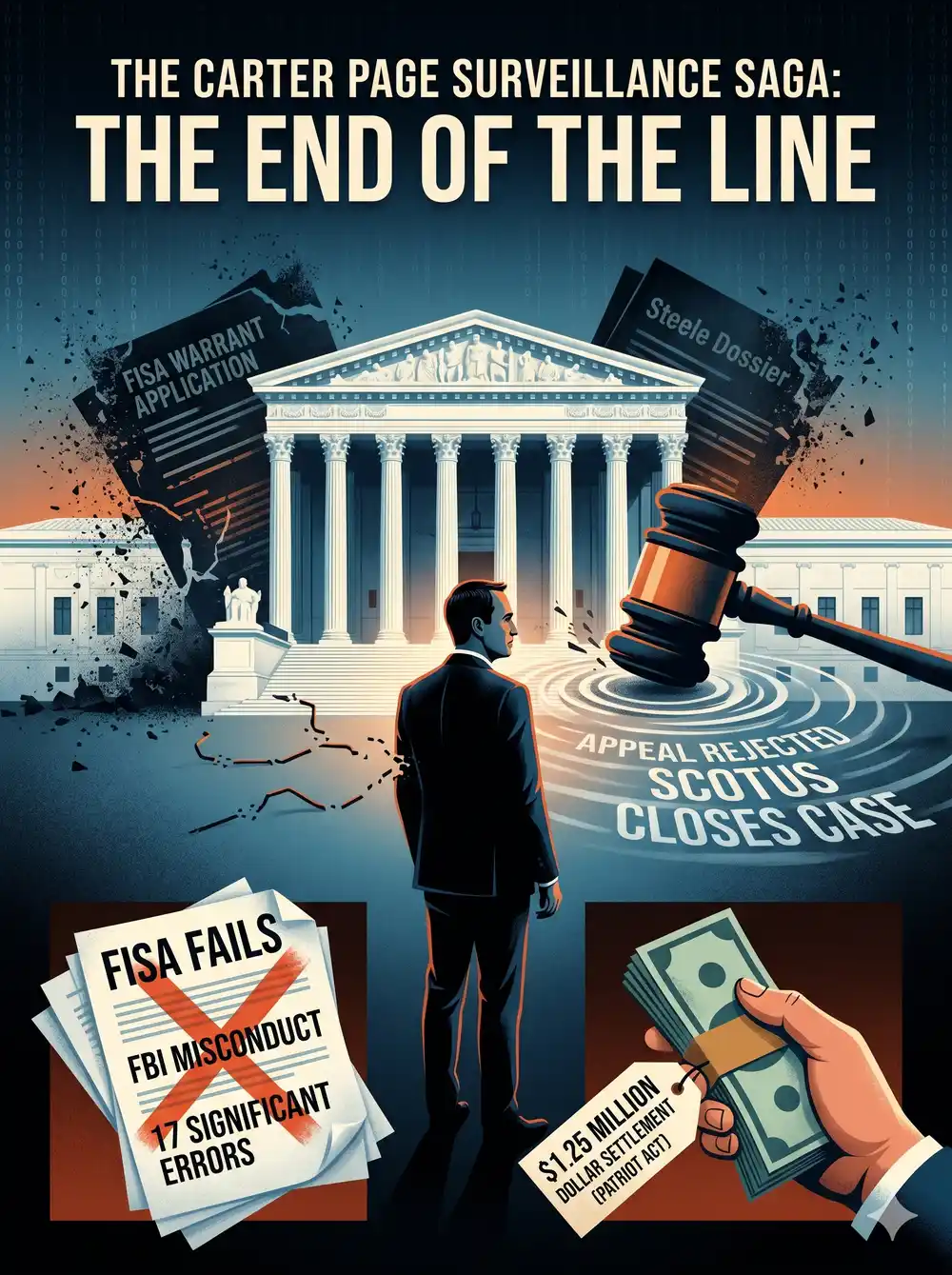
On Monday, the Supreme Court officially turned away Carter Page’s attempt to revive his lawsuit against former FBI Director James Comey and other senior FBI officials.
Page originally filed his lawsuit in November 2020. He alleged that the FBI’s surveillance of him was unlawful because the applications submitted to the secretive Foreign Intelligence Surveillance Act (FISA) court were false, misleading, and heavily reliant on unverified political opposition research.
By declining to hear the case, the Supreme Court has effectively killed Page’s legal avenues for holding individual FBI personnel personally liable for the surveillance.
The Partial Victory: A $1.25 Million Settlement
While Page lost his battle against James Comey and individual agents, he did not walk away completely empty-handed.
In April of this year, the Justice Department under the Trump administration reached a $1.25 million settlement with Page. However, this deal came with heavy caveats. The settlement resolved only Page’s claims against the U.S. government as an entity, not the individual FBI officials who orchestrated the surveillance. Furthermore, the payout was tied strictly to a claim Page raised under the PATRIOT Act, completely sidestepping his allegations regarding FISA violations.
To pursue the FBI officials individually for the FISA warrants, Page had to win his appeal—an effort that SCOTUS has now definitively shut down.
Why Did Page Lose? It Wasn’t About the Facts
If you followed the DOJ Inspector General’s investigation into the Crossfire Hurricane probe, you might be wondering how Page’s lawsuit failed.
After all, the Justice Department’s internal watchdog notoriously found that the FBI made 17 “significant errors and omissions” in its initial 2016 application and three subsequent renewal requests to surveil Page. The Inspector General heavily criticized the bureau for relying on the infamous “Steele dossier”—a compilation of salacious, unproven opposition research compiled by ex-British intelligence officer Christopher Steele. The FBI itself later admitted that it should have terminated its surveillance of Page far earlier than it did.
So, if the government admitted it botched the warrants, why was the lawsuit dismissed?
The answer: The ticking clock.
In 2022, U.S. District Judge Dabney L. Friedrich dismissed Page’s lawsuit, a decision that was affirmed by the U.S. Court of Appeals for the D.C. Circuit in 2024. The courts did not rule that the FBI’s behavior was flawless; rather, they ruled that the statute of limitations barred Page’s assertions. Simply put, the courts decided Page waited too long to file his claims against the federal entities and personnel involved.
The Takeaway
Carter Page’s legal journey is a fascinating case study in the gap between government misconduct and legal liability. It serves as a stark reminder that in the realm of federal litigation, procedural hurdles like the statute of limitations can easily override even documented, admitted bureaucratic failures.
Page’s name is permanently etched into the history of American intelligence controversies, and his ordeal forced major internal audits of the FISA court process. But as far as civil litigation goes, the Supreme Court has ensured that his legal fight ends here.
Quoted Sources Report: This article relies on reporting by Melissa Quinn, published by CBS News.

Leo Falsafi is a digital marketing veteran and senior journalist at Virlan.co, where he covers the intersection of digital marketing, gaming, and breaking US trending news. With nearly two decades of hands-on experience in SEO and digital strategy, Leo has consulted for and scaled hundreds of companies. His deep industry roots allow him to deliver sharp, fact-checked insights and analysis on the trends shaping today’s digital landscape.