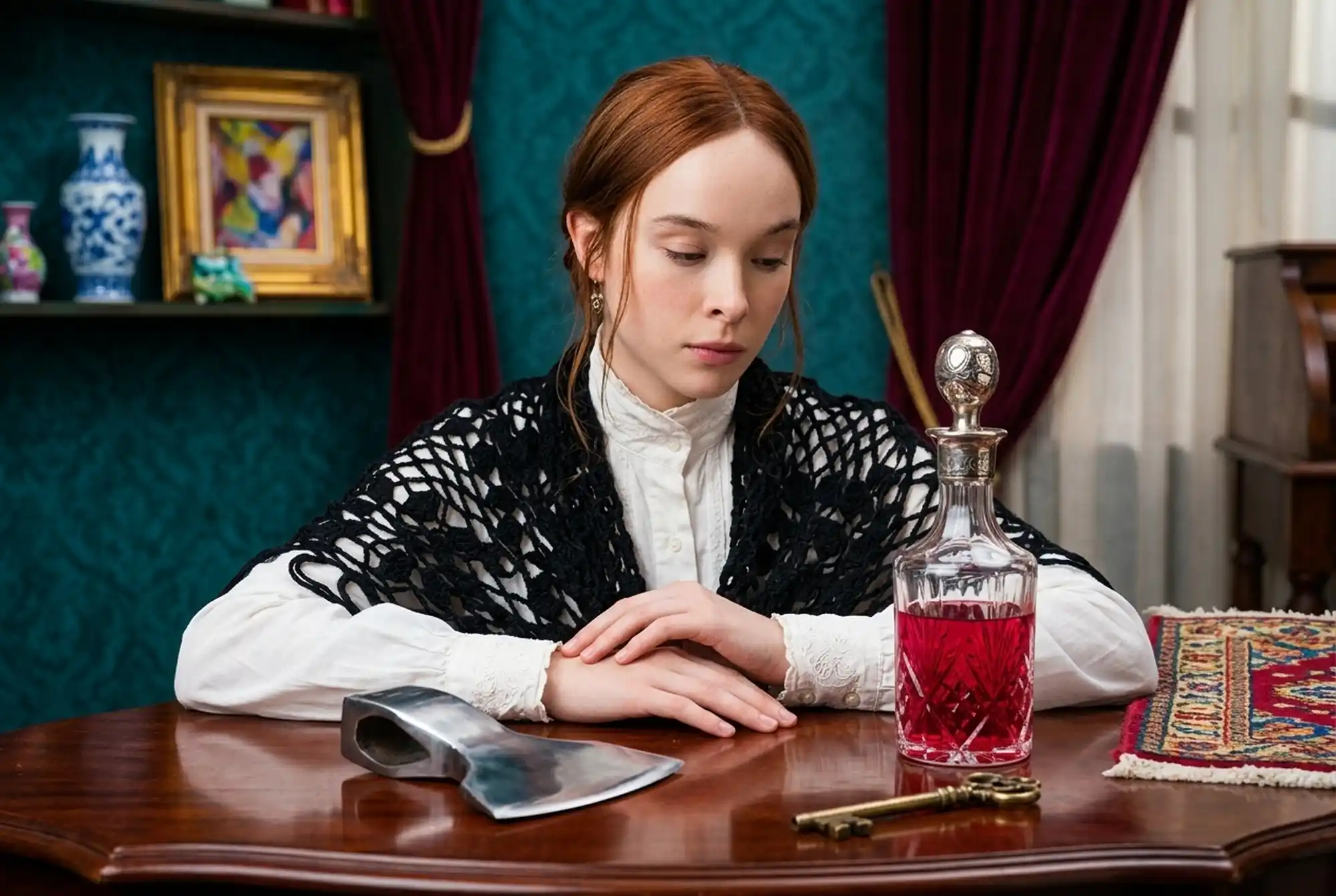
The show dropped September 17. The debates it’s sparked go far deeper than the axe.
By the time Lizzie Borden swung that axe in 1892 — allegedly, the courts reminded everyone — Fall River, Massachusetts had already made up its mind. So had the nursery rhyme. So, apparently, has Netflix.
Monster: The Lizzie Borden Story landed on September 17, 2026, all eight episodes at once, the way Netflix always does when it wants you to lose a weekend. It’s the fourth installment in Ryan Murphy collaborator Ian Brennan’s Monster anthology, and it’s the first time the franchise has turned its lens on a woman alleged to have done the killing. That alone was enough to set the internet humming. But three days in, the conversation has moved somewhere stranger and more interesting than the usual true-crime talking points — and most of the big outlets are still back at the trailer.
Here’s what people are actually asking about, and what the show’s promotional machine hasn’t been loud about.
Ella Beatty Is Carrying the Show — and She’s Barely 22
The searches aren’t lying: people want to know who plays Lizzie Borden, and the answer is Ella Beatty, daughter of Warren Beatty and Annette Bening. She’s 22. She’s playing one of the most psychologically loaded figures in American criminal history. And based on early audience reaction, she’s pulling it off in a way that critics — currently giving the show a 50% Rotten Tomatoes score — are underselling.
What the reviews gloss over is how Beatty plays Lizzie: not as a monster, not as a martyr, but as someone suffocating quietly in a house that has never once considered what she might want from life. It’s a slow-burn performance that rewards patience, which may explain why audiences conditioned by Dahmer-style spectacle are rating it at 29% on the same platform. Two very different shows would satisfy those two groups. Beatty is making the patient one.
The Bridget Sullivan Question Is the Real Story Nobody’s Telling
Here’s the search term lighting up right now: Bridget Sullivan. And here’s why.
The show leans into a long-debated historical theory — that Lizzie Borden had a romantic, possibly sexual, relationship with the Bordens’ live-in Irish maid, Bridget Sullivan (who the Borden family called “Maggie,” a detail the show keeps). Vicky Krieps plays Sullivan, and the dynamic between her and Beatty’s Lizzie is, depending on your read, the emotional spine of the entire series.
Social media is split — loudly — on whether this is bold queer historical reclamation or irresponsible revisionism dressed up in period costume. The historians are not thrilled. The actual historical record on Lizzie and Bridget is thin: they coexisted in the same house, Bridget gave testimony that was notably measured, and she quietly left Fall River not long after the acquittal. That’s it. Everything else is speculation.
Netflix and the show’s promotional material haven’t exactly been upfront about how central this thread is to the narrative. People are finding out episode three or four and going back to social media to either celebrate or complain. That buried lede is driving a lot of the current search traffic — people want to know before they start watching, and nobody told them.
Charlie Hunnam Said What About Lizzie Borden?
The quote making rounds in certain corners of Reddit and X — though largely absent from mainstream coverage — comes from Charlie Hunnam, who plays Andrew Borden, Lizzie’s father. In a behind-the-scenes interview, Hunnam described Lizzie’s alleged actions as “understandable” when placed in the context of the era’s constraints on women, and made a comparison to Ed Gein that landed badly with some listeners.
The comment isn’t malicious — he’s making a contextual point about desperation — but it’s the kind of thing that sounds significantly worse as a pull quote than it does in full, and it has people side-eyeing the show’s framing before they’ve even pressed play.
Rebecca Hall Is the Villain, and She’s Magnificent
If Beatty is the heart of the show, Rebecca Hall as Abby Borden — Lizzie’s stepmother, and one of the two people found dead on that August morning — is the reason to stick around. Critics who like the show like it partly because of Hall, who plays Abby not as a cartoonish obstacle but as a woman who has also been shaped, and warped, by the same airless domestic world that’s suffocating Lizzie.
It creates a genuinely uncomfortable effect: you understand why Lizzie might want Abby gone, and you also understand why Abby is the way she is, and neither of those understandings points you toward a comfortable villain. Hall has said she has ideas for where the Monster franchise might go next, which she’s keeping private — a tease that’s generating quiet speculation about whether she’s staying involved as a producer.
What’s Sarah Paulson Actually Doing in This?
The searches asking about Sarah Paulson in Monster: Lizzie Borden are slightly confused, and it’s worth clarifying: Paulson plays Aileen Wuornos — but not in the main Borden storyline. The eighth and final episode makes a thematic pivot, drawing a connection between Lizzie Borden’s alleged crimes and Aileen Wuornos, the Florida serial killer whose story was the basis for the 2003 Charlize Theron film Monster.
It’s a structural choice that’s dividing people almost as sharply as the Bridget Sullivan question. The argument for it: both women operated in systems that had no legitimate place for them, and their violence — alleged or documented — was shaped by that. The argument against: forcing a narrative bridge between a Victorian acquittee and a documented serial killer is a stretch that flattens both stories into a thesis about Female Rage™ rather than examining either life on its own terms.
Netflix also separately has a documentary, Aileen: Queen of the Serial Killers, using archival footage and prison interview tapes, which is getting conflated with this show in search results. They’re different projects. Paulson in episode eight of Lizzie Borden is fiction; the documentary is archival.
The Nance O’Neil Angle Is Undersearched and Overdue
People are searching Nance O’Neil, and most of them are doing it because the show introduced them to a figure they’d never heard of. That’s actually one of the more interesting things Monster: The Lizzie Borden Story does quietly.
O’Neil was a real person: a stage actress of considerable fame in the early 1900s who became close with Lizzie Borden after her acquittal. Their relationship — which involved Lizzie hosting lavish parties for O’Neil’s theater troupe at her new house, “Maplecroft,” funded by her inheritance — was scandalous enough that her sister Emma moved out in protest and never reconciled with Lizzie.
Jessica Barden plays O’Neil in the series, and the character functions as both a window into Lizzie’s post-trial life and a symbol of everything the acquittal actually gave her access to: money, freedom, and a social world that wouldn’t have existed for her while her father lived.
The historical Nance O’Neil is a genuinely compelling figure whose connection to Lizzie has never gotten a proper telling. That the show buries her in search traffic behind cast lists and Sarah Paulson’s name is a minor tragedy.
The Lizzie Borden House Is Still There, and Still Taking Bookings
For those searching the Lizzie Borden house: yes, it’s still standing at 92 Second Street in Fall River, Massachusetts. It operates as a bed and breakfast and museum. You can sleep in the room where the murders happened, which is either a fascinating piece of living history or exactly the kind of thing that makes the victim’s-rights advocates in the true-crime discourse understandably furious.
The house has predictably seen a spike in search interest since September 17. Whether that translates into bookings is between Fall River and its visitors. The house’s own social media has been pointedly quiet about the Netflix series, which is a choice.
The Bigger Question the Show Is Asking — and Not Quite Answering
Stripped of the controversy, Monster: The Lizzie Borden Story is doing something genuinely ambitious: it’s trying to hold two truths at once. The first is that Lizzie Borden lived in conditions that would make almost anyone snap. The second is that two people are dead, and the show bears some responsibility to them.
Where Dahmer — the previous Monster season — was criticized for aestheticizing its subject at the expense of victims, the Lizzie Borden season at least tries to grapple with Abby Borden as a full person. Whether it succeeds is where the 50/29% split lives.
The social media audiences rating it at 29% aren’t wrong that the show is slow, thesis-heavy, and more interested in structural analysis than in the visceral true-crime machinery that made Dahmer appointment viewing. They came for an axe. They got a sociology lecture with excellent costumes.
Whether that’s a failure or a feature depends entirely on what you wanted from a show called Monster — and that ambiguity, more than anything else, is why it’s still trending.
Monster: The Lizzie Borden Story is streaming now on Netflix. All eight episodes are available.

Leo Falsafi is a digital marketing veteran and senior journalist at Virlan.co, where he covers the intersection of digital marketing, gaming, and breaking US trending news. With nearly two decades of hands-on experience in SEO and digital strategy, Leo has consulted for and scaled hundreds of companies. His deep industry roots allow him to deliver sharp, fact-checked insights and analysis on the trends shaping today’s digital landscape.