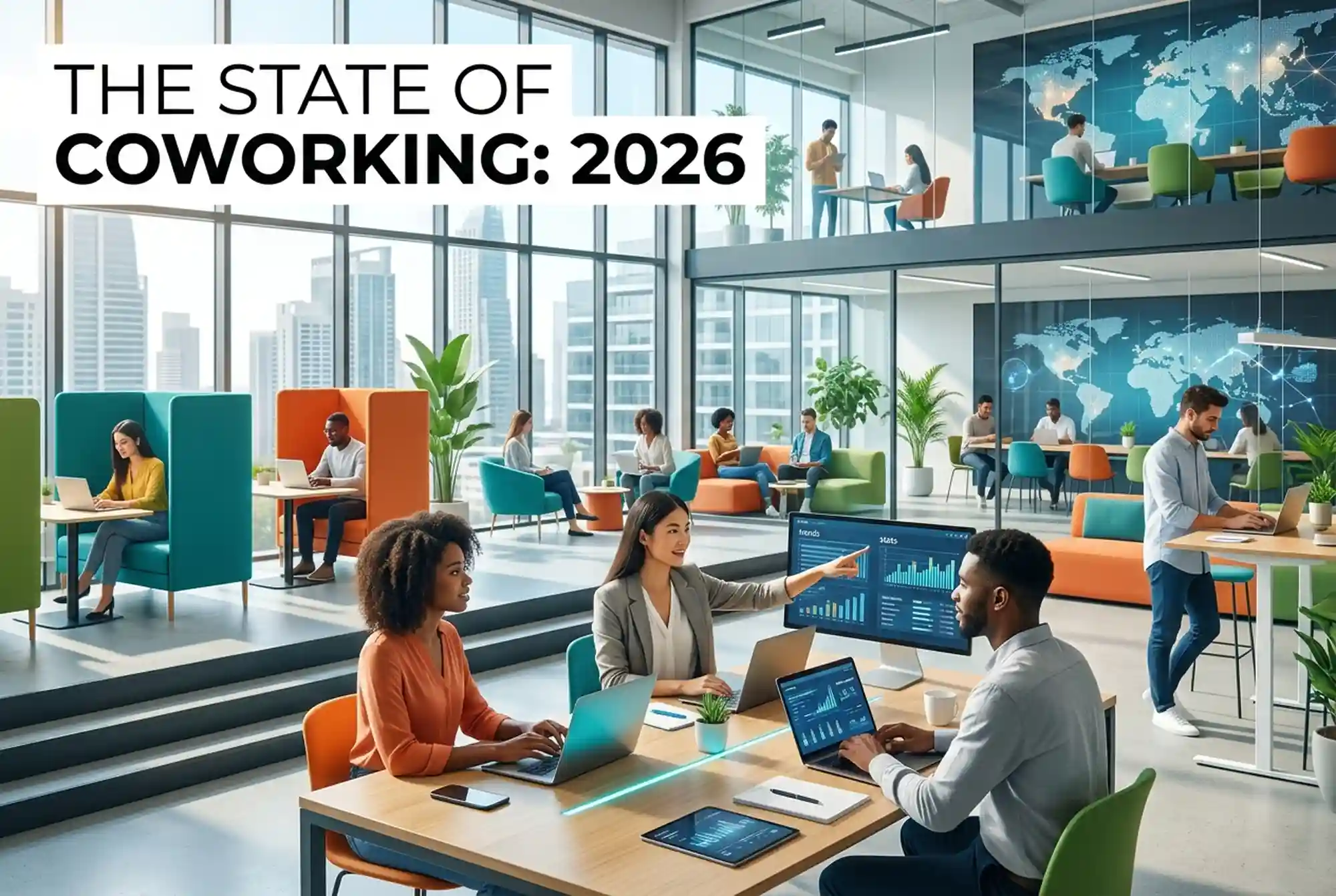
Coworking was supposed to be a niche solution for freelancers. It became a mainstream workplace strategy — and 2026 is the year the numbers make that impossible to argue with.
The global coworking market is worth $30.12 billion this year, up from $26.2 billion in 2025. There are now 42,000 coworking spaces operating worldwide, with another 2,000 projected to open before year’s end. In the United States alone, coworking occupies over 166 million square feet across nearly 9,400 locations — roughly 2.34% of all commercial real estate in the country.
This is not a trend. It’s a structural shift in how people work.
This report pulls together the most current data on the coworking industry — market size, membership, the rise of suburban spaces, AI adoption, wellness, corporate demand, sustainability, and where the sector is heading. Whether you’re evaluating a membership, running a space, or making real estate decisions, these are the numbers that matter in 2026.
How to Choose a Coworking Space: The Complete Guide (2026)
Market Size and Growth
The headline is straightforward: coworking is growing fast, and the trajectory shows no signs of flattening.
Key figures for 2026:
- Global market size: $30.12 billion (up 15% from $26.2B in 2025)
- Number of spaces globally: ~42,000, expected to reach 44,000 by year end
- US locations: 8,973 as of January 2026 — a 15% increase in 12 months
- US coworking footprint: 166.36 million square feet across 9,384 locations (Q2 2026)
- Median monthly membership cost: $219/month (Q2 2026)
- Projected market size by 2034: $51.99 billion at a 17.95% CAGR
North America holds the largest market share at 41.2%, but the fastest growth is happening in Asia-Pacific, which accounts for 23.2% of global revenues and is expanding at a rate that outpaces both Europe and North America. Europe is projected to grow from $12.93 billion in 2026 to $18.2 billion by 2031.
The global coworking market is not slowing down. It’s broadening — moving into new geographies, new demographics, and new use cases.
Types of Coworking Spaces Explained: Hot Desks, Dedicated Desks, Private Offices & More (2026)
Hybrid Work Is the Engine
Coworking doesn’t grow in a vacuum. It grows because the way people work has changed — and 2026’s hybrid work data explains why coworking demand keeps accelerating.
Hybrid work in 2026:
- 52% of remote-capable US employees now work in hybrid arrangements (Gallup)
- 88% of US employers offer at least some hybrid options
- 83% of workers prefer a hybrid model combining remote and in-office time
- 64% of business leaders report their company operates a hybrid model
- 55% of job seekers rank hybrid as their preferred arrangement
The office hasn’t died — but the five-day commute to one fixed location has. What’s replaced it is something more distributed: some days at home, some at a company hub, and some somewhere in between. That “somewhere in between” is increasingly a coworking space.
What’s notable in 2026 is that hybrid work is no longer a temporary accommodation — it’s baked into employment contracts, real estate strategies, and HR policies at scale. Coworking is no longer filling a gap in the hybrid model; it IS a core part of how hybrid works.
The 10 Best Coworking Spaces Manhattan
Trend 1: The Third Workplace Is Here
The single most important coworking trend of 2026 is geographic: the rise of the “third workplace.”
The concept is simple. People don’t want to commute 60–90 minutes to a city-center office. They also don’t want to work from home every day. The solution — a professional workspace within 15 minutes of home — is the third workplace.
The data backs this up in force:
- 65% of new coworking memberships in 2025–2026 were purchased for locations within a 15-minute commute of the member’s home
- Suburban coworking grew 58% versus just 4% growth in urban markets since 2023
- Suburban coworking locations expanded 39% in two years: from 4,484 locations in July 2024 to 6,247 in July 2026
- Suburban occupancy grew 25% year-over-year
- JLL projects 45% of net-new coworking desks through 2035 will be located outside traditional city centers
The implications are significant. Operators who planted flags only in downtown business districts are watching growth concentrate in neighborhoods, suburbs, and smaller cities. The opportunity — and the competition — has moved closer to where people actually live.
For workers, this is unambiguously good news. A professional space five minutes from home delivers the focus and community of a traditional office without the commute that made it unsustainable. The “15-minute city” concept — where work, errands, and life all coexist in proximity — is finding a natural ally in neighborhood coworking.
Trend 2: Corporate Demand Has Gone Mainstream
Coworking began with freelancers. In 2026, enterprises are its fastest-growing customer segment.
Corporate adoption of flexible space:
- 58% of corporate occupiers now use flexible space in some form
- 77% of companies operate hybrid models — the primary driver of enterprise coworking demand
- Employees of established companies account for ~36% of total coworking membership
- Enterprise users make up over 40% of new flexible space commitments
- 45% of coworking memberships are now paid or subsidized by employers — not out-of-pocket freelancer spend
This is a fundamental shift in who coworking is for. Large companies are using coworking spaces as satellite offices, giving distributed employees a professional local option rather than forcing a commute to a central HQ. They’re using flex space for project teams that need a temporary dedicated space without a long-term lease. And they’re using it as a real estate hedge — taking flexible commitments while their office needs remain uncertain.
Flexible office space is no longer viewed as a workaround. It’s a core real estate strategy for a significant share of the corporate market — and the forecast reflects it. The flexible office market overall (including managed offices and enterprise flex) is projected to reach $194.75 billion by 2034.
- The 10 Best Coworking Spaces Manhattan
- Top 10 Best Cafes To Work From In New York – UPDATED
- The 10 Best Coworking Spaces in Denver (2026 Pricing & Reviews)
- Best Coworking Spaces in Bangkok 2026: Top 10 Ranked, Reviewed & Priced
- Best Coworking Spaces in Singapore 2026: Top 10 Ranked & Reviewed
- Best Coworking Spaces in Kuala Lumpur 2026: Top 10 Ranked & Reviewed
- 10 Best Coworking Spaces in Oregon (2026): Ranked, Reviewed & Priced
- The 10 Best Coworking Spaces in New York City: 2026 Ranked Data
Trend 3: AI Is Reshaping How Spaces Operate
Walk into a modern coworking space and you may not see the AI — but it’s running the building.
The integration of artificial intelligence into coworking operations is one of the defining operational shifts of 2025–2026:
- AI-powered booking systems can detect booked-but-empty meeting rooms via Wi-Fi sensors within 15 minutes of the reservation — automatically freeing capacity
- Dynamic pricing powered by AI lifts revenue per available membership (RevPAM) by 8–15% at spaces that have deployed it
- Community managers using AI tools can handle twice the member load compared to peers without AI assistance
- Operators report achieving ROI within 4–6 months of AI deployment — with meeting room yield improvements arriving in the first 30–60 days
- LiDAR sensors (3D laser mapping technology) are being used for detailed space utilization analysis in premium spaces
A survey of over 300 operators across 15 countries found that the primary stated goal of AI adoption in coworking is to free community managers’ time for relationship-building — not to reduce headcount. The insight is that the human quality of a coworking space is its competitive moat, and AI handles the logistics so people can focus on the people.
The downstream effect for members: better room availability, smarter pricing, and staff who are less buried in admin and more available to actually help.
Trend 4: Wellness Has Become a Core Amenity
The shift from “wellness” as a marketing add-on to a genuine operational priority is one of the more substantive changes in coworking’s design and programming in 2026.
Wellness in coworking spaces:
- Wellness now ranks in the top 3 most desired amenities across recent industry surveys
- A 2025 Taylor & Francis study found coworking produces higher wellbeing, work engagement, and productivity compared to home-based work
- Mental health-related searches from workplace contexts increased 21% between 2020 and 2025 — the most-searched workplace wellbeing category
- 69% of workers cite work-life balance and flexibility as the most helpful factors for their mental wellbeing
- 59% of workers prioritize access to mental health benefits and self-care resources
The design response has been concrete: biophilic elements (plants, natural light, living walls), dedicated meditation and quiet rooms, in-house wellness programming, fitness partnerships, and a growing number of spaces with on-site mental health resources or partnerships with therapy platforms.
The broader point is that coworking — done right — already addresses several wellbeing problems that remote work creates. The isolation of working from home, the inability to separate work from domestic life, and the absence of spontaneous social interaction are all things a good coworking space solves structurally. Operators who understand this are leaning into wellness not as a perk, but as a core product differentiator.
Trend 5: The Digital Nomad Economy Is Expanding
The coworking industry has always had a symbiotic relationship with location-independent workers. In 2026, that relationship has scaled to a size that now influences real estate decisions globally.
Digital nomad population in 2026:
- 43 million digital nomads worldwide as of 2026
- 18.5 million in the United States alone — roughly 12% of the US workforce
- 75% are Millennials or Gen Z (40% Millennial, 35% Gen Z)
- 80 million nomads projected by 2030
- 66 countries now offer digital nomad visas — a policy response to the scale of location-independent work
The most popular nomad coworking destinations have become established markets in their own right: Lisbon, Bali, Medellín, Mexico City, Bangkok, and Chiang Mai now have mature coworking ecosystems built substantially around nomad demand.
For the coworking industry, this population represents a distinct customer segment with specific needs: flexible day passes, global network access, fast and reliable internet, and a community of like-minded workers rather than local professionals. Spaces that understand nomads as a distinct persona — rather than treating them as occasional drop-ins — are outperforming on occupancy in their markets.
Trend 6: Sustainability Is Becoming Non-Negotiable
Sustainability has moved from coworking marketing language to baseline expectation among members, corporate clients, and increasingly, regulators.
What’s changing in 2026:
- Energy-efficient systems, water conservation, waste management, and eco-friendly materials are now standard specifications in new coworking builds — not differentiators
- Biophilic design (green spaces, natural light, living walls) has become a near-universal feature in premium spaces
- AI-enabled HVAC control and personalized lighting systems are actively reducing energy consumption and carbon footprints
- ESG frameworks and green building certifications (LEED, BREEAM, WELL) are increasingly required by enterprise clients as part of their own sustainability commitments
The business case is straightforward: enterprises with their own ESG commitments need their real estate — including flexible space — to meet sustainability standards. A coworking space that can’t demonstrate green credentials is invisible to that segment of the market.
Beyond the enterprise angle, there’s a structural sustainability argument for coworking that’s underappreciated: shared space is inherently more resource-efficient than individual offices. A 100-person coworking floor uses significantly less energy, water, and physical material than 100 individual offices. As the sector becomes more explicit about this argument, it’s finding traction with environmentally conscious members.
Trend 7: AI Search Is Now a Real Traffic Channel
This is the trend that most coworking operators aren’t watching yet — but will need to in 2026.
AI-powered search tools (ChatGPT, Perplexity, Google AI Overviews, Gemini) are now a primary discovery channel for services including coworking spaces. When someone asks ChatGPT “what’s the best coworking space in Austin for a startup,” it generates an answer — citing specific spaces, pulling from reviews, articles, and structured content across the web.
The implication is that coworking spaces need to optimize not just for traditional Google rankings, but for how AI systems read and surface their information:
- Clear, factual content structured for easy AI extraction (tables, bullet lists, direct Q&A)
- Explicit FAQ sections that answer the exact queries AI tools respond to
- Strong presence in review platforms that AI tools frequently cite
- Published data and statistics that establish authority and citability
Spaces and publications that adapt to AI search early will hold meaningful first-mover advantages in their markets. This is a content strategy consideration as much as an SEO one.
By the Numbers: 2026 Coworking at a Glance
| Metric | 2026 Figure |
|---|---|
| Global market size | $30.12 billion |
| YoY market growth | 15% |
| Coworking spaces globally | ~42,000 |
| US locations | 8,973 |
| US coworking footprint | 166.36M sq ft |
| Median US membership cost | $219/month |
| Global average occupancy | 68% |
| Suburban coworking growth (since 2023) | +58% |
| New memberships near home (≤15 min) | 65% |
| Employer-subsidized memberships | 45% |
| Corporate occupiers using flex space | 58% |
| Digital nomads worldwide | 43 million |
| Countries with nomad visas | 66 |
| Projected market size by 2034 | $51.99 billion |
What This Means for Different Stakeholders
If you’re a worker or freelancer evaluating coworking
The market has never offered more options — or more variation in quality. Suburban and neighborhood spaces are proliferating rapidly, which means you likely have more options close to home than you did two years ago. Median pricing has stayed relatively accessible at $219/month. The wellness data is genuinely encouraging: coworking outperforms home working on wellbeing, engagement, and productivity by meaningful margins.
If you’re a startup or small team
Enterprise coworking demand is driving premium product development at the high end — but it’s also pushing operators to compete harder on quality across all tiers. Private office supply is increasing in most major markets. The negotiating environment for small teams has improved.
If you’re a corporate real estate or HR leader
Flexible space is no longer a fringe option. 58% of corporate occupiers already use it in some form, and the data on hybrid work suggests that share will only grow. The question isn’t whether to include flex space in your portfolio — it’s how to structure the allocation strategically.
If you’re a coworking operator
The suburban opportunity is real and the data is unambiguous. AI tools for operations are delivering measurable ROI within months. Wellness amenities are increasingly a table stake rather than a differentiator. And enterprise clients — your highest-value segment — are becoming sustainability-literate. The operators who move on these trends first will build defensible advantages before the market catches up.
What Comes Next
The coworking sector in 2026 is building toward several things that will define the industry through 2030:
- Further suburban densification — the pipeline of neighborhood spaces being opened by both independent operators and major networks is substantial, and the occupancy data supports continued investment
- AI-native space management — the early adopters are demonstrating ROI; mainstream deployment across the sector will reshape operating economics significantly
- Enterprise as the dominant customer — the shift from freelancer-led to enterprise-led demand changes what operators prioritize: reliability, security, compliance, and scalability over community events and ping-pong tables
- Wellness as core product — the wellbeing data is sufficiently strong that operators who treat wellness as an afterthought will lose ground to those who build around it
- Nomad infrastructure maturing — 66 countries with nomad visas, 43 million nomads, and 80 million projected by 2030 represents a demand pool that will sustain an entire segment of the coworking market for years
The headline: coworking is no longer a niche, a trend, or a response to a pandemic. It’s infrastructure — as fundamental to the modern working world as broadband and smartphones.
Frequently Asked Questions
The global coworking market is valued at $30.12 billion in 2026, up 15% from $26.2 billion in 2025. It is projected to reach $51.99 billion by 2034 at a compound annual growth rate of approximately 18%.
Approximately 42,000 globally as of early 2026. The United States alone has nearly 9,000 locations, occupying over 166 million square feet of commercial real estate.
Yes, substantially. The global market grew 15% year-over-year in 2026. Suburban coworking specifically grew 58% compared to 2023. The US saw a 15% increase in the number of locations in just the past 12 months.
The membership base has diversified significantly. Freelancers and remote workers remain a core segment, but employees of established companies now account for ~36% of memberships, and 45% of all memberships are now paid or subsidized by employers. Digital nomads — a population of 43 million globally — represent a distinct and growing segment.
The most impactful trend is geographic: the rise of suburban and neighborhood coworking driven by the 15-minute commute preference. 65% of new memberships in 2025–2026 were at locations within 15 minutes of the member’s home, and suburban coworking has grown at more than 10x the rate of urban coworking since 2023.
The data is positive. A 2025 academic study found coworking produces higher wellbeing, work engagement, and productivity compared to home-based work. 74% of coworking members report higher productivity, and 89% report being happier at work since joining a coworking space.

Leo Falsafi is a digital marketing veteran and senior journalist at Virlan.co, where he covers the intersection of digital marketing, gaming, and breaking US trending news. With nearly two decades of hands-on experience in SEO and digital strategy, Leo has consulted for and scaled hundreds of companies. His deep industry roots allow him to deliver sharp, fact-checked insights and analysis on the trends shaping today’s digital landscape.