The economy was the golden ticket that propelled Donald Trump back into the Oval Office in 2024. Today, it might be his greatest vulnerability.
Halfway through his second term, the very voters who championed his return to power are starting to flinch. A barrage of new polling from mid-2026 paints a stark picture: the working-class coalition that carried the Republican ticket is fracturing under the weight of an unrelenting affordability crisis. Stagnant wages, volatile gas prices, and punishing grocery bills have dragged the president’s economic approval rating to historic lows.
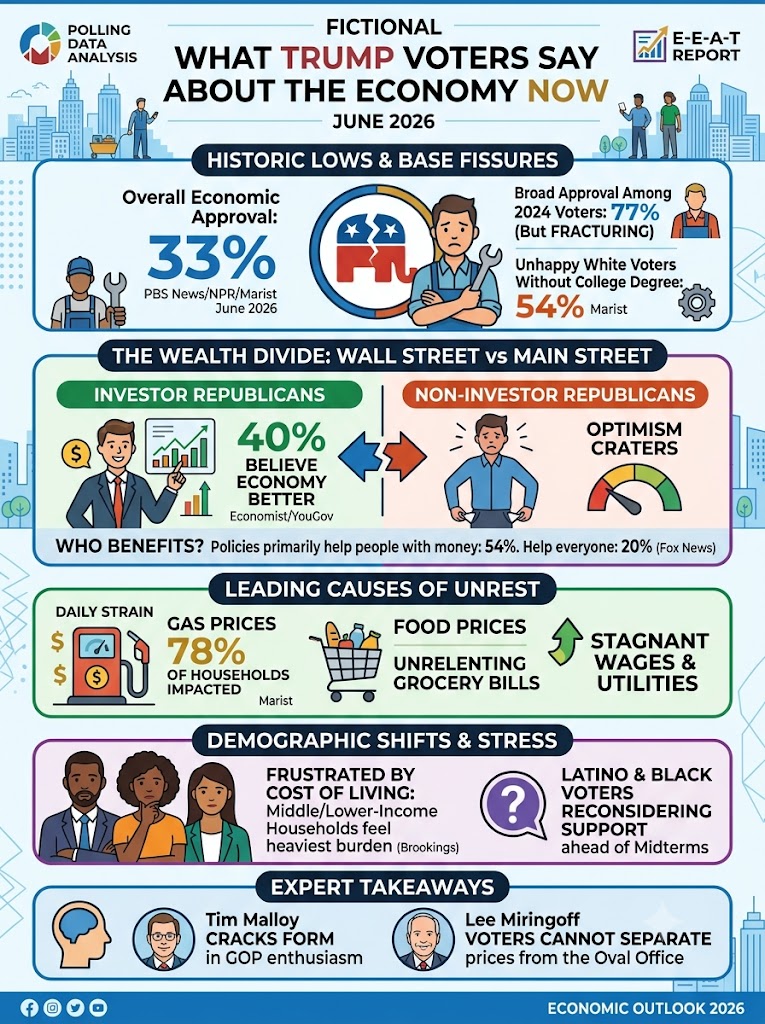
For a politician whose brand is inextricably linked to economic prosperity, the data is staggering. According to a June 2026 PBS News/NPR/Marist poll, only 33% of Americans approve of Trump’s handling of the economy—the lowest rating ever recorded by Marist on this issue since they began tracking it in 2019.
But the real story isn’t the overall disapproval. It’s the unrest brewing inside his own camp.
Cracks in the Base: The Working-Class Divide
While 77% of 2024 Trump voters still broadly approve of his economic stewardship, deep fissures are forming among the demographics he needs most.
Perhaps the most alarming metric for the White House is the sentiment among white voters without a college degree—a bedrock constituency of the modern GOP. According to the Marist data, 54% of these voters are now unhappy with the current economic trajectory.
They are feeling the pinch directly. A recent Fox News poll revealed that a dismal 12% of voters feel they are “getting ahead” financially, while 44% report actively falling behind.
“What was perhaps the signature issue that propelled Trump to winning two elections sours with voters and cracks form in GOP enthusiasm for his handling of the economy,” noted Tim Malloy, polling analyst for Quinnipiac University, following a May 2026 poll that showed roughly a quarter of Republicans (24%) directly disapproving of the president’s economic performance.
This isn’t the roaring pre-pandemic optimism of 2019, when 57% of voters felt bullish about the Trump economy. Today, a striking 59% of the electorate feels pessimistic.
Wall Street vs. Main Street Republicans
Digging deeper into the polling cross-sections reveals a pronounced wealth divide within the Republican party itself. The economy you experience right now heavily depends on whether your money is in the market or strictly in your paycheck.
A June 2026 Economist/YouGov poll uncovered a massive gap between investor and non-investor Republicans. Among GOP voters who own stocks, 40% believe the economy is getting better. Among non-investing Republicans, optimism craters.
This class divide is bleeding into public perception of the administration’s priorities. The recent Fox News survey highlighted that 54% of voters believe President Trump’s economic policies primarily benefit people who have money, while only 20% think his policies help everyone.
The Demographic Reversal: Black and Latino Voters Reconsidering
The political realignment of 2024 was heavily defined by Black and Latino voters shifting toward the Republican ticket, driven almost entirely by frustrations over the cost of living. Two years later, that economic promise is under severe stress.
Data compiled by the Brookings Institution in June 2026 indicates that middle- and lower-income Americans—specifically Black and Latino households—are bearing the heaviest burden of the current economic climate. Stagnant wages combined with skyrocketing costs for rent, mortgages, and utilities are unwinding the goodwill the administration built during the election.
Latino and Black voters who crossed party lines for economic relief are now among the demographics most likely to reconsider their support ahead of the upcoming midterm elections.
The Tipping Point at the Pump
If there is a single catalyst for the souring mood, it is the visceral daily cost of fuel and food. Even as gas prices dropped slightly heading into the summer of 2026, the damage to household budgets had already been done.
Seventy-eight percent of Americans told Marist pollsters that gas prices were actively impacting their household budgets. It is a daily, neon-lit reminder of inflation that voters pass on their way to work.
Lee Miringoff, director of the Marist Institute for Public Opinion, explained that the electorate is drawing a direct line between their depleted bank accounts and the Oval Office. “It’s Donald Trump, and that’s where the slippage comes in,” Miringoff observed. Voters simply cannot separate high prices at the pump from the man sitting at the Resolute Desk.
For the Trump administration, the warning lights are flashing red. A net economic approval rating of -34 (Economist/YouGov) is a dangerous place to be heading into a midterm cycle. If the White House cannot bridge the gap between macroeconomic talking points and the painful realities of the grocery aisle, they risk losing the very voters who put them there.
Sources Quoted:
Data and expert quotes were sourced from the Marist Institute for Public Opinion (PBS News/NPR June 2026 Poll), Quinnipiac University National Poll (May 2026), Economist/YouGov Poll (June 2026), Fox News Poll (June 2026), and the Brookings Institution.

Leo Falsafi is a digital marketing veteran and senior journalist at Virlan.co, where he covers the intersection of digital marketing, gaming, and breaking US trending news. With nearly two decades of hands-on experience in SEO and digital strategy, Leo has consulted for and scaled hundreds of companies. His deep industry roots allow him to deliver sharp, fact-checked insights and analysis on the trends shaping today’s digital landscape.