The search landscape has fundamentally fractured. Three years ago, a local business could secure a top-three spot in the Google Map Pack and comfortably capture the lion’s share of regional market demand. Today, consumer behavior operates on a vastly more complex, multi-touchpoint grid.
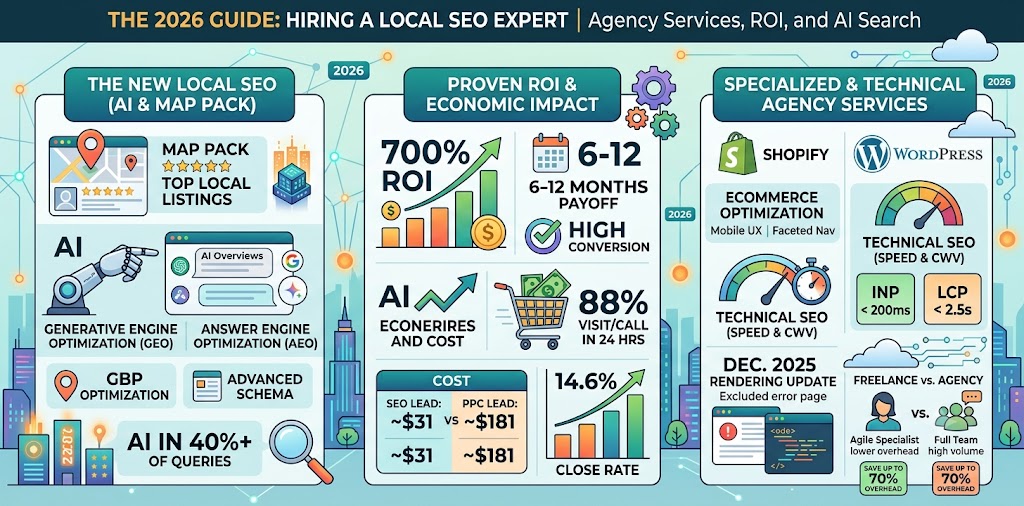
You are no longer just optimizing for a map. You are optimizing for Generative Engine Optimization (GEO), Answer Engine Optimization (AEO), and an increasingly fragmented mobile discovery process. According to 2026 data from Salesgenie, 84% of consumers search online for local businesses daily. Yet, despite this massive volume, many small-to-medium businesses are bleeding capital into outdated digital retainers that yield zero measurable revenue.
Finding a local SEO expert in this environment requires ruthlessness. It demands an understanding of hard data, the new mechanics of AI-driven visibility, and the ability to spot the difference between an agency that sells arbitrary traffic and one that engineers localized revenue.
The Raw Economics of Local SEO Services
Before auditing a local SEO agency, you must understand the financial baseline of what a successful campaign actually looks like in 2026. The data is unequivocal: organic search remains the most lucrative acquisition channel for local businesses.
A comprehensive 2026 industry report by First Page Sage revealed that the median ROI for SEO is 748%. When isolated specifically to local SEO services, the return averages a massive 700%, typically achieving a full payoff within 6 to 12 months.
Why is the return so disproportionately high? Intent.
When a user executes a local search, the friction between discovery and transaction is razor-thin. SeoProfy reports that 4 out of 5 mobile local searches lead to a purchase, often within hours. Furthermore, 88% of consumers who conduct a local search on their smartphone visit or call a store within a single day.
This intent translates directly into close rates. According to HubSpot’s tracking, SEO leads close at an average rate of 14.6%. Compare that to traditional outbound strategies—like cold calling or direct mail—which languish at a 1.7% close rate. Organic leads cost an average of $31 each, whereas PPC (Pay-Per-Click) leads cost $181. The math heavily favors the localized organic engine, provided the agency executing the strategy understands the modern playbook.
The 2026 Shift: AI Overviews and the Dual-Channel Search
The most profound shift in local search is the integration of artificial intelligence into the discovery process. Top local SEO agencies recognize that local visibility is now a dual-channel game.
You still need to dominate the traditional Google Local 3-Pack. However, you must simultaneously earn citations in AI summaries. Data from SeoProfy indicates that 40.16% of local business queries now trigger Google’s AI Overviews. For specific service categories, such as legal or cleaning services, AI answer boxes appear in over 60% of searches.
A modern local SEO expert does not just clean up directory citations. They focus heavily on Google Business Profile (GBP) optimization, which 76% of marketers now rank as the most valuable local SEO service. Furthermore, elite agencies are building entity associations, implementing advanced local schema markup, and generating citation-worthy local content that Large Language Models (LLMs) like ChatGPT, Gemini, and Perplexity can easily parse and verify.
In fact, a 2026 B2B local services engagement tracked by Rankmax found that AI search traffic converted at 6.24%, nearly double the 3.29% conversion rate of traditional organic search.
Business owners evaluating these services often ask the same critical questions regarding timelines and financial returns:
What is the average ROI from a high-quality SEO campaign?
A high-quality SEO campaign averages an ROI of 748%, meaning for every dollar invested, the business sees a return of $7.48. In high-transaction-value industries, such as real estate or medical devices, this number routinely scales past 1,000%.
How long does it take to see results from an SEO campaign?
Initial traction and baseline indexing improvements typically surface within 6 to 12 months. However, the peak compounding results—where traffic and revenue begin to scale exponentially without a parallel increase in monthly spend—generally occur 2 to 3 years into a sustained campaign.
Separating an Elite Local SEO Expert from the Pretenders
Choosing the wrong agency costs far more than their monthly retainer. It costs you regional market share, months of wasted time, and potential algorithmic penalties.
Outpace SEO’s 2026 hiring guide presents a brilliant framework for identifying elite talent: “A strategic agency will respond to your goals with questions about your sales funnel, average deal size, and customer lifetime value. A tactical agency will respond with a keyword list.”
When vetting a local SEO agency, look for these specific operational signatures:
- Revenue Mapping: They do not sell you on “getting to page one.” They model out how a 20% increase in local visibility will translate to your specific Q3 sales targets.
- Deep GBP Focus: They prioritize the management of your Google Business Profile over arbitrary blog posting. A verified, fully optimized GBP listing secures up to seven times more clicks than a neglected one.
- Review Strategy Infrastructure: Reputation is a ranking factor. 89% of consumers are more likely to choose a business that responds to all reviews. A premier agency implements systems to safely acquire, monitor, and respond to local reviews.
- Transparent Access: They grant you unrestricted administrative access to your Google Analytics, Search Console, and all third-party tracking tools.
AI & Search Engines
- Dominant Market Value: The median ROI for a local SEO campaign in 2026 is 700%, driven by organic leads that close at an average rate of 14.6%.
- High-Intent Conversion: 88% of mobile users who conduct a local search visit or call the business within 24 hours.
- The AI Search Evolution: Over 40% of local business queries now trigger Google AI Overviews, requiring a shift toward Generative Engine Optimization (GEO) alongside traditional map pack strategies.
- Primary Agency Service: Google Business Profile (GBP) management remains the most critical service offered by local SEO experts, directly influencing both local pack rankings and AI entity verification.
- Strategic Agency Identification: Elite SEO agencies focus on customer lifetime value and full-funnel revenue metrics rather than superficial keyword ranking reports.
The shift toward AI-driven search has not just altered local SEO; it has fundamentally reorganized the specialized sectors of e-commerce, technical infrastructure, and the gig economy. As the ecosystem fractures into distinct disciplines, hiring a generalist agency is a mathematical risk. In 2026, the demand has pivoted toward hyper-specialized experts who understand the structural nuances of specific platforms and rendering engines.
The Shopify & eCommerce SEO Expert: Escaping the Conversion Trap
The e-commerce landscape is currently defined by a stark contradiction: massive consumer volume masked by brutal conversion averages. While e-commerce SEO generates an impressive 5.2x ROI over a 36-month period, extracting that return requires surgically precise platform management.
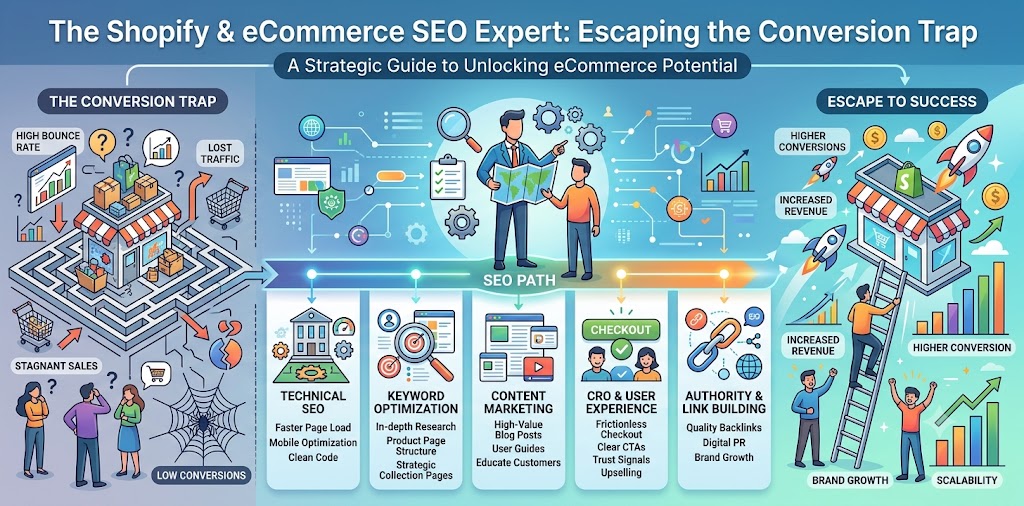
Nowhere is this more evident than on Shopify. By 2026, Shopify powers over 5.54 million active stores worldwide, commanding 30% of U.S. e-commerce sales. However, the platform’s accessibility hides a chilling baseline metric: the average Shopify store converts just 1.4% to 1.8% of its visitors. Over 98% of traffic leaves without making a purchase.
A true Shopify SEO expert does not merely optimize title tags. They engineer paths out of this low-conversion trap by fixing platform-specific architectural flaws.
- Faceted Navigation & Index Bloat: Shopify automatically generates complex parameter-based URLs for product filters (size, color, price). Without strict canonicalization and
robots.txtgovernance, search engines waste crawl budget indexing thousands of duplicate pages. - Mobile-First UX Verification: With 79% of Shopify traffic now originating from mobile devices, elite e-commerce experts are migrating brands to high-performance themes (like Dawn) and utilizing next-gen image formats (AVIF) to speed up mobile product discovery.
- Collection Page Dominance: A premium e-commerce SEO strategy structures collection pages as central, authoritative hubs. Shallow URL depth ensures that any product is reachable within three clicks from the homepage, consolidating link equity.
The WordPress & Technical SEO Expert: The 2026 Rendering Shift
If e-commerce SEO is about conversion economics, technical SEO is about algorithmic survival. In 2026, page speed is no longer a UX nicety—it is a rigid, measurable revenue lever.
Google’s Core Web Vitals are enforced as strict ranking thresholds. According to Digital Applied, a simple one-second delay in page load time kills 7% of conversions. Furthermore, if a page load increases from one second to three seconds, the probability of a bounce spikes by 32%.
A modern technical SEO expert operating on WordPress or custom enterprise stacks must manage these strict metrics while navigating Google’s updated rendering rules.
- The December 2025 Rendering Shift: Google recently clarified its rendering pipeline behavior, stipulating that pages returning non-200 HTTP status codes (such as 4xx or 5xx errors) may be excluded from the rendering queue entirely. This is catastrophic for poorly configured Single Page Applications (SPAs).
- Interaction to Next Paint (INP): The strict 2026 threshold for INP is under 200 milliseconds. Technical experts are achieving this by utilizing Incremental Static Regeneration (ISR)—the new gold standard for architecture—to pre-build HTML and bypass heavy client-side JavaScript execution.
- Index Budgeting: The most efficient site is no longer the one with the most pages indexed, but the one with the highest ratio of quality pages. Technical experts now aggressively prune low-value URLs to protect the site’s “index budget.”
Freelance SEO Experts vs. Agencies: The Cost-Efficiency Pivot
As the technical demands of SEO have increased, the financial models for acquiring this talent have fractured. In 2026, businesses are actively rebelling against bloated agency retainers.
The traditional SEO agency model bundles strategist time, writer time, and overhead into a $3,000 to $10,000 monthly fee. Yet, surveys indicate that 67% of small businesses report dissatisfaction with agency transparency. Consequently, companies are migrating toward two highly efficient alternatives: the specialized freelance SEO expert and AI-automated platforms.
Freelance consultants offer targeted, senior-level expertise—often charging $150 to $300 hourly, or $800 to $2,500 monthly—while stripping out the 60-70% overhead costs associated with full-service agencies. Because they operate as agile specialists, you can hire a freelance technical SEO for a strict site-speed audit without signing a 12-month retainer for content creation you don’t need.
Simultaneously, the lower tier of SEO execution is being rapidly commoditized. AI SEO platforms (such as ARC AI and Stacc) now execute automated keyword research, on-page optimization, and daily publishing for a flat $99 to $499 monthly fee. This forces human SEO experts—whether freelance or agency—to abandon basic execution and focus entirely on high-level strategic planning, ROI mapping, and technical crisis management.
Do I need a platform-specific expert (like a Shopify or WordPress SEO), or just a generalist?
In 2026, platform specialization is critical. A generalist might understand keyword theory, but a platform expert understands how to override Shopify’s automated sitemap limitations, or how to secure a WordPress site against heavy plugin-induced JavaScript blocking that ruins Core Web Vitals.
When should a business hire a freelance SEO consultant instead of an agency?
Hire a freelancer when you have a specific, isolated bottleneck—such as migrating a website, recovering from an algorithmic penalty, or auditing technical site speed. Hire an agency or build an in-house team when you need high-volume content production paired with multi-channel digital PR.
- E-Commerce Conversion Baseline: The average Shopify store converts at just 1.4% to 1.8%, requiring e-commerce SEO experts to focus intensely on technical UX and collection architecture to drive profitability.
- The ROI of eCommerce Search: When executed properly, e-commerce SEO generates a massive 5.2x return on investment over a 36-month horizon.
- Strict Core Web Vitals Impact: A three-second delay in page load speed increases bounce rates by 32%, forcing technical SEOs to target LCP times under 2.5 seconds and INP times under 200 milliseconds.
- Google Rendering Protocol: Following the late-2025 pipeline shift, search engines will drop pages with non-200 status codes from the rendering queue, prioritizing architectures like Incremental Static Regeneration (ISR).
- The Freelance Cost Advantage: Specialized freelance SEO experts and independent consultants cut agency overhead by up to 70%, offering targeted technical audits without requiring $5,000+ monthly retainers.
Sources Quoted:
Data and strategic insights were extracted from 2026 industry reports, technical documentations, and publications including Reboot Online, SeoProfy, Digital Applied, Yotpo, Wytlabs, theStacc, ARC Affiliates, and Moonrank.
Data and strategic insights were extracted from 2026 industry reports and publications including First Page Sage (via theStacc), Salesgenie, SeoProfy, Outpace SEO, Rankmax, HubSpot, and BrightLocal.
Leo Falsafi is a digital marketing veteran and senior journalist at Virlan.co, where he covers the intersection of digital marketing, gaming, and breaking US trending news. With nearly two decades of hands-on experience in SEO and digital strategy, Leo has consulted for and scaled hundreds of companies. His deep industry roots allow him to deliver sharp, fact-checked insights and analysis on the trends shaping today's digital landscape.