
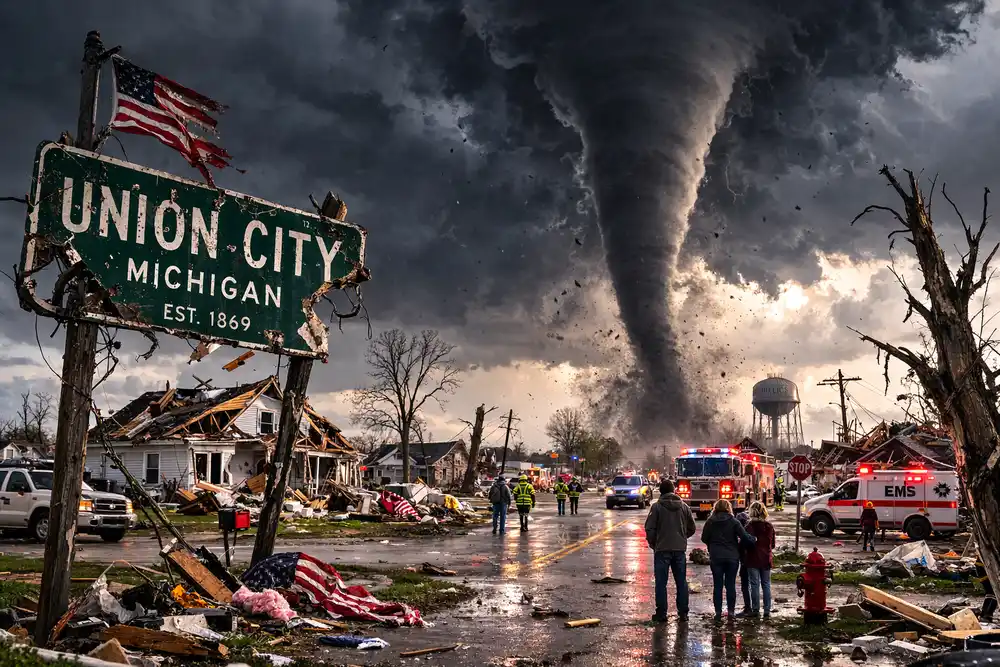
The unprecedented fury of a deadly tornado outbreak has ripped through Michigan, with the small community of Union City bearing the brunt of a particularly devastating strike on March 7, 2026. What made this event so profoundly striking was not just the sheer destructive power of the twisters, but their unusual intensity and frequency in a state not typically synonymous with severe tornado outbreaks, leaving a trail of unimaginable damage and prompting urgent questions about changing weather patterns in the Midwest.
March 7, 2026, will forever be etched into Michigan’s history as the day a series of deadly storms and tornadoes defied conventional expectations, transforming tranquil landscapes into scenes of devastation. While the Midwest and Plains are accustomed to severe weather, the ferocity and location of this particular outbreak have meteorologists and residents alike grappling with a sobering new reality.
Union City, Michigan Tornado: A Community Shaken
The heart of the disaster lay squarely in Union City, Michigan, a tight-knit community that found itself directly in the path of one of the most powerful tornadoes. Witnesses described a terrifying roar, followed by a sudden, violent assault that leveled homes, ripped apart businesses, and scattered debris for miles. Emergency services were immediately overwhelmed, battling blocked roads and severe structural damage to reach those trapped. The immediate aftermath revealed a landscape scarred beyond recognition, a testament to the raw power of nature. Residents of Union City, MI, now face the daunting task of rebuilding, not just their homes, but the very fabric of their lives.
Michigan Tornadoes: An Unsettling New Reality?
While Michigan experiences tornadoes annually, the scale and destructive capability of the twisters witnessed on March 7th were profoundly unusual. Historically, the state’s tornadoes tend to be less frequent and generally weaker than those found in traditional ‘Tornado Alley’ states. This event, however, presented a series of intense, long-track tornadoes, challenging long-held perceptions about where and how severely such storms can manifest. The question on everyone’s mind is whether this outbreak is an anomaly or a chilling indicator of evolving severe weather patterns that could see Michigan tornadoes become a more common and dangerous threat.
Weather Storms Tornadoes: The Broader Outbreak’s Grip
The Union City disaster was part of a larger, severe weather outbreak that swept across the Midwest and Plains. States from Iowa to Ohio reported powerful thunderstorms, torrential rain, and multiple tornado warnings throughout the day. This widespread atmospheric instability created the perfect conditions for the development of supercell thunderstorms, which ultimately spawned the destructive tornadoes that impacted Michigan today. The National Weather Service (NWS) had issued extensive warnings, highlighting the significant threat, yet the sheer scope and sudden intensification of some systems proved challenging even for advanced forecasting models.
Three Rivers Michigan: Neighboring Communities Grapple with Aftermath
Just a short distance from Union City, the community of Three Rivers, Michigan, also felt the brutal force of the storms. While not as directly impacted by a major touchdown, Three Rivers, MI, experienced significant damage from high winds, hail, and torrential rainfall, contributing to widespread power outages and localized flooding. The solidarity between these neighboring towns became immediately apparent, with emergency crews and volunteers from Three Rivers rushing to assist in Union City’s rescue and recovery efforts. The shared ordeal underscores the interconnectedness of these rural communities when faced with such an overwhelming disaster.
The National Weather Service’s Critical Role
In the lead-up to and during the outbreak, the National Weather Service played an indispensable role in issuing timely and urgent tornado warnings for Michigan. Forecasters worked tirelessly, utilizing advanced radar technology to track the dangerous storms, allowing precious minutes for residents to seek shelter. Their precise alerts for areas like Union City and Three Rivers Michigan undoubtedly saved lives. Post-event assessments are already underway by NWS meteorologists to analyze the storm’s dynamics, path, and impact, providing crucial data that will help refine future forecasting and emergency response strategies for severe weather events across the nation.
As the immediate shock begins to subside, the focus shifts to recovery and resilience. The deadly tornado in Michigan has left an indelible mark, prompting communities to unite, adapt, and prepare for a future where such extreme weather may no longer be considered rare.