
When the world’s most lucrative media franchise decides to step outside its traditional turn-based RPG roots, magic happens. For decades, The Pokémon Company has experimented with nearly every genre imaginable, morphing its pocket monsters into strategy warriors, pinball bumpers, and digital photographers.
But which side adventures truly stand the test of time?
Drawing upon historic sales data, critical consensus, and legacy impact, we’ve analyzed the best Pokémon spin-off games that proved the franchise could thrive in entirely new dimensions.
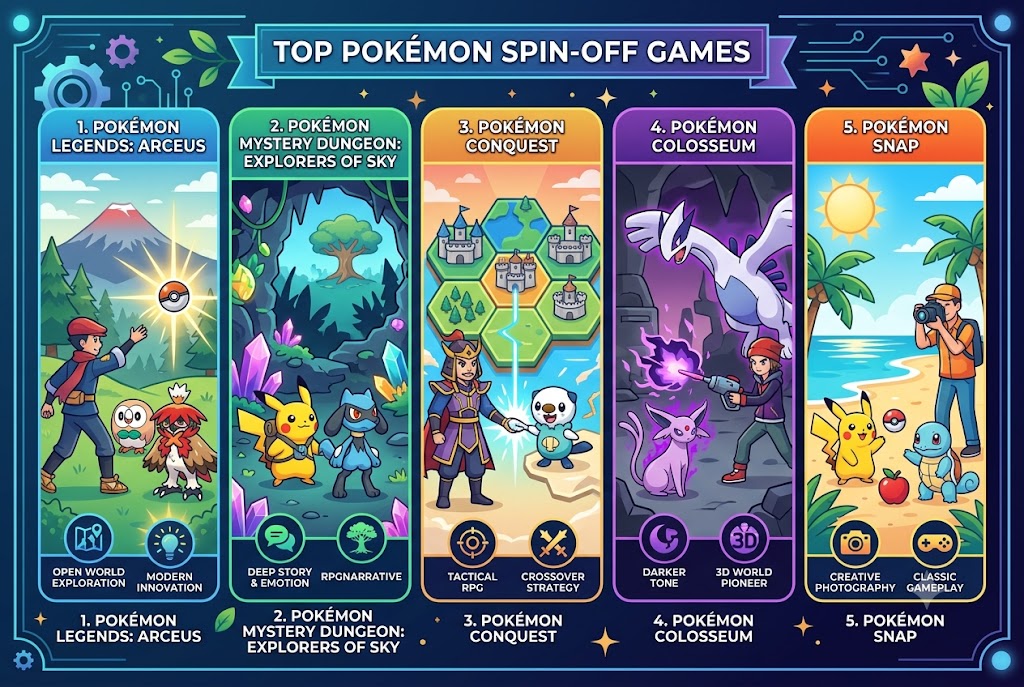
The Strategy Masterpiece: Pokémon Conquest
Released for the Nintendo DS in 2012, Pokémon Conquest is the strategy crossover that nobody asked for, yet it blossomed into an undeniable cult classic.
Fusing the tactical grid-based combat of the Nobunaga’s Ambition series with the elemental type-matchups of Pokémon, this title was a massive swing. Set in the Sengoku-era Ransei region, players command Warlords who “link” with their partner Pokémon to conquer opposing armies. Reviewing the game for Nintendo Life, critic Joe Walker perfectly summarized the appeal, describing it as a delicious treat where “Pokémon is the flaky crust and Nobunaga’s Ambition the warm gooey centre”.
Despite operating within the niche tactical-RPG genre, Conquest moved over 1 million units globally. The strategic depth of hunting down a “Perfect Link” for every warrior offered incredible replay value, proving that the monster-catching series could hold its own alongside grid-combat heavyweights like Final Fantasy Tactics.
The Narrative Peak: Pokémon Mystery Dungeon: Explorers of Sky
If you ask the hardcore community to name the greatest storyline in Pokémon history, Explorers of Sky will dominate the conversation.
Serving as the enhanced version of Explorers of Time and Darkness, this DS adventure flipped the script: you aren’t a human trainer capturing monsters; you are a human transformed into a Pokémon. Moving a highly respectable 1.49 million copies, the game excels at environmental storytelling and emotional stakes.
IGN highlights this sub-series for successfully showcasing the mystical abilities of the world’s legendary creatures, rather than just locking them behind simple Pokédex text descriptions. The bond you forge with your partner Pokémon—whom you can actually speak to—cements a relationship that culminates in a genuinely life-changing credit roll.
3D Pioneers with a Dark Edge: Pokémon Colosseum & XD: Gale of Darkness
Long before the Nintendo Switch brought mainline titles into full 3D environments, Pokémon Colosseum dared to completely reinvent the franchise aesthetic for the Nintendo GameCube in 2004.
The game was a runaway commercial success, selling an impressive 2.41 million copies worldwide, with 1.15 million units moved in the United States alone. But it wasn’t just the leap to 3D that captivated audiences; it was the shockingly dark tone. You play as a hero rescuing “Shadow Pokémon” whose hearts have been artificially closed, purifying them so they can grow stronger. By stripping away the traditional “beating Gym Leaders” narrative and focusing on a more mature plot, Colosseum—and its acclaimed 2005 sequel XD: Gale of Darkness—delivered an edgy experience that players still beg Nintendo to replicate today.
The Arcade & Photography Classics: Pokémon Pinball and Snap
Sometimes, the simplest deviations are the most effective. GameSpot’s Kevin Knezevic correctly identifies 1999’s Pokémon Snap and Pokémon Pinball as two of the earliest, yet absolute best offshoots in the franchise’s history.
In Pokémon Snap on the Nintendo 64, you play as Todd Snap, a photographer hired by Professor Oak to explore diverse island ecosystems. It laid the groundwork for a beloved genre that was finally revitalized on the Switch over two decades later.
Meanwhile, Pokémon Pinball for the Game Boy Color (co-developed by HAL and Jupiter) somehow managed to marry the frantic arcade energy of pinball with the methodical RPG mechanics of Pokémon. Splitting its digital tables into “Red” and “Blue” versions with unique elements, it captured the essence of the mainline games while creating one of the most fun digital pinball titles of the era.
The “Is It a Spin-Off?” Titan: Pokémon Legends: Arceus
Is it a mainline game, or is it a spin-off? While The Pokémon Company officially groups it with core titles, major outlets like IGN rank Pokémon Legends: Arceus at the very top of their spin-off lists—and for excellent reason.
Legends: Arceus was the first “Open Zone” title in the franchise’s history. It unapologetically unshackled the series from its restrictive 3D formulas. Giving players the freedom to seamlessly throw a Poké Ball in the overworld without engaging in tedious, multi-turn battles felt like a complete revelation. Tasked with building the first-ever Pokédex in the ancient Sinnoh region, this prequel modernized the Pokémon gameplay loop while providing some of the series’ most captivating lore revelations.
Whether it’s the sheer smartphone domination of Pokémon GO or the calculated grid tactics of Conquest, the Pokémon universe is vast. These games prove that Pikachu and friends don’t just belong in turn-based arenas—they can conquer the gaming world from almost any angle.
Sources Quoted:
Data, quotes, and critical insights were directly sourced from reviews by Joe Walker (Nintendo Life), Kevin Knezevic (GameSpot), editorial rankings by IGN, Wikipedia, and legacy sales figures archived by VGChartz.

































Leave a Reply