
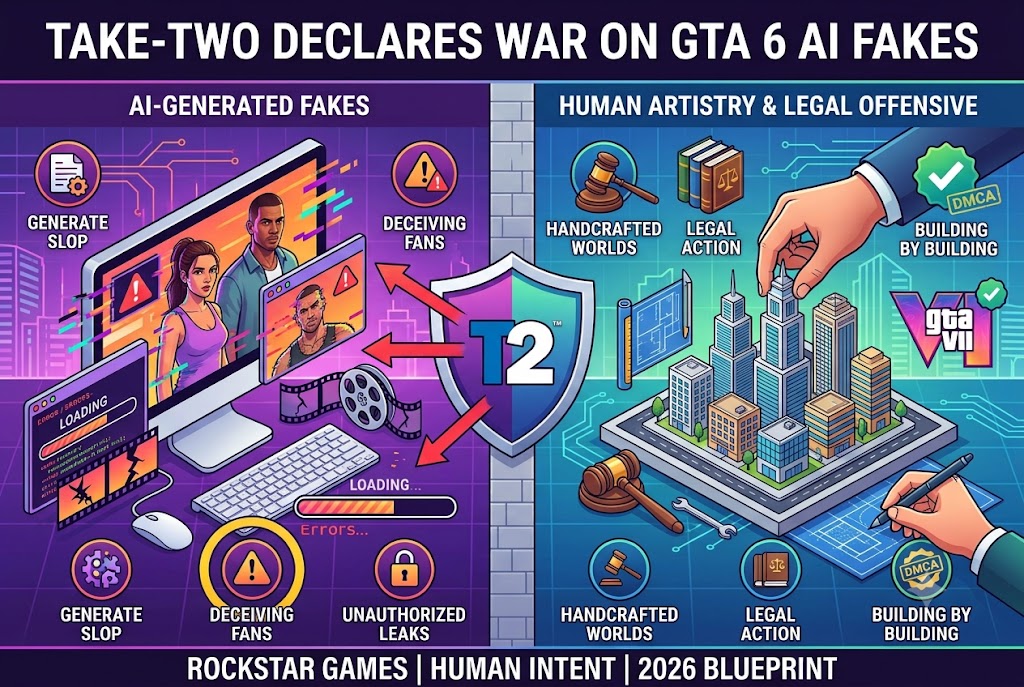
In a video game industry increasingly obsessed with automated shortcuts, Rockstar Games is drawing a distinct line in the sand. With the monumental launch of Grand Theft Auto VI locked in for November 19, 2026, parent company Take-Two Interactive has launched a ruthless legal offensive. The target? A rising tide of hyper-realistic, AI-generated “leaks” that are actively deceiving millions of desperate fans.
This is no standard corporate copyright sweep. It is a philosophical defense of human artistry in an era of machine-generated content, setting the stage for what is arguably the most anticipated entertainment release in history.
The DMCA Crackdown on Hyper-Realistic AI Fakes
For months, an information drought surrounding GTA 6 has left a vacuum that artificial intelligence was more than happy to fill. Modern AI video generation tools have become startlingly sophisticated, effectively erasing the obvious telltale signs of early 2023 models—such as melting faces and nonsensical text.
Recently, Take-Two began aggressively stepping up its Distributed Copyright Act (DMCA) enforcement across social media platforms to nuke these convincing fabrications. A prime target of this legal sweep was the YouTube channel “Vice Nation,” which had been successfully baiting fans with incredibly detailed, AI-generated shorts of protagonists Lucia and Jason riding scooters and shopping.
The clips were dangerously convincing. By mimicking the aesthetic and UI of Rockstar’s proprietary engine, they misled vast swaths of the gaming community into believing they were viewing authentic, leaked gameplay. Take-Two intervened decisively, wielding copyright claims over the unauthorized use of the brand’s original resources and logos to disable the videos.
But this cleanup effort isn’t just about protecting intellectual property—it’s about clearing the runway. Analysts note that this sweeping removal of AI counterfeit footage is a necessary step to prevent misinformation ahead of Take-Two’s August 7th earnings report. Traditionally, the publisher drops major trailers on or just before these shareholder meetings, igniting fierce speculation that a third official GTA 6 trailer is imminent.
A Handcrafted Rebellion Against “Generative Slop”
Underneath the legal maneuverings lies a much deeper creative manifesto. Take-Two CEO Strauss Zelnick has repeatedly and emphatically shut down the notion that generative AI will build the streets of Leonida.
“Generative AI has zero part in what Rockstar Games is building,” Zelnick confirmed in a recent interview. “Their worlds are handcrafted. That’s what differentiates them. They’re built from the ground up, building by building, street by street, neighborhood by neighborhood.”
In an industry where giants like Ubisoft and EA are pivoting hard toward generative AI to draft dialogue and populate environments at scale, Rockstar’s rejection of the technology for creative assets is a staggering financial bet on human intent. Zelnick does not mince words when assessing the current state of AI artistry, stating flatly that the technology is fundamentally backward-looking because it relies on existing data sets.
“There is no creativity that can exist by definition in any AI model, because it is data-driven,” Zelnick noted at a Technology Executive Council Summit. “Could we push a button tomorrow and create an equivalent to the Grand Theft Auto marketing plan? The answer is no… I am of the view that you wouldn’t end up with anything very good. You end up with something pretty derivative.”
The Double-Edged Sword of AI at Take-Two
Despite Zelnick’s hardline stance on creative assets, it would be inaccurate to label Take-Two as a luddite organization. The publisher is highly enthusiastic about AI—strictly as a tool for backend efficiency.
Take-Two currently provides its staff with enterprise versions of ChatGPT and Claude, overseeing roughly 200 internal projects and “hundreds of pilots” designed to integrate AI into executive and programming workflows. They are already seeing these tools drive major cost and time efficiencies. However, a strict firewall remains between AI as a productivity enhancer and AI as a substitute for human imagination.
“Do I think tools by themselves create great entertainment properties? No, there’s no evidence that’s the case,” Zelnick reiterated.
The Road to November 2026
Rockstar can afford this purist approach largely because of the unprecedented financial cushion provided by GTA V and its online ecosystem, which has generated billions of dollars over the last decade. That war chest has allowed the studio to delay the game’s internal spring 2025 target by 18 months, ensuring the final product meets the studio’s standard for perfection without triggering investor panic.
When GTA 6 finally hits the PlayStation 5 and Xbox Series X/S on November 19, 2026, it will arrive as a premium, human-authored experience. Pricing tiers are expected to range from a standard $69.99 up to potential premium packages reaching $119.99.
As the marketing campaign prepares to ramp up, Take-Two’s message to the industry—and to the modders flooding YouTube with AI fakes—is crystal clear: You cannot automate a masterpiece.
Sources Quoted:
Data, release timelines, and executive quotes were sourced from industry reports and interviews originally published by GamesIndustry.biz, Eurogamer (Matt Wales), The Next Web (TNW), Vietnam.vn, and TechPowerUp.


































Leave a Reply